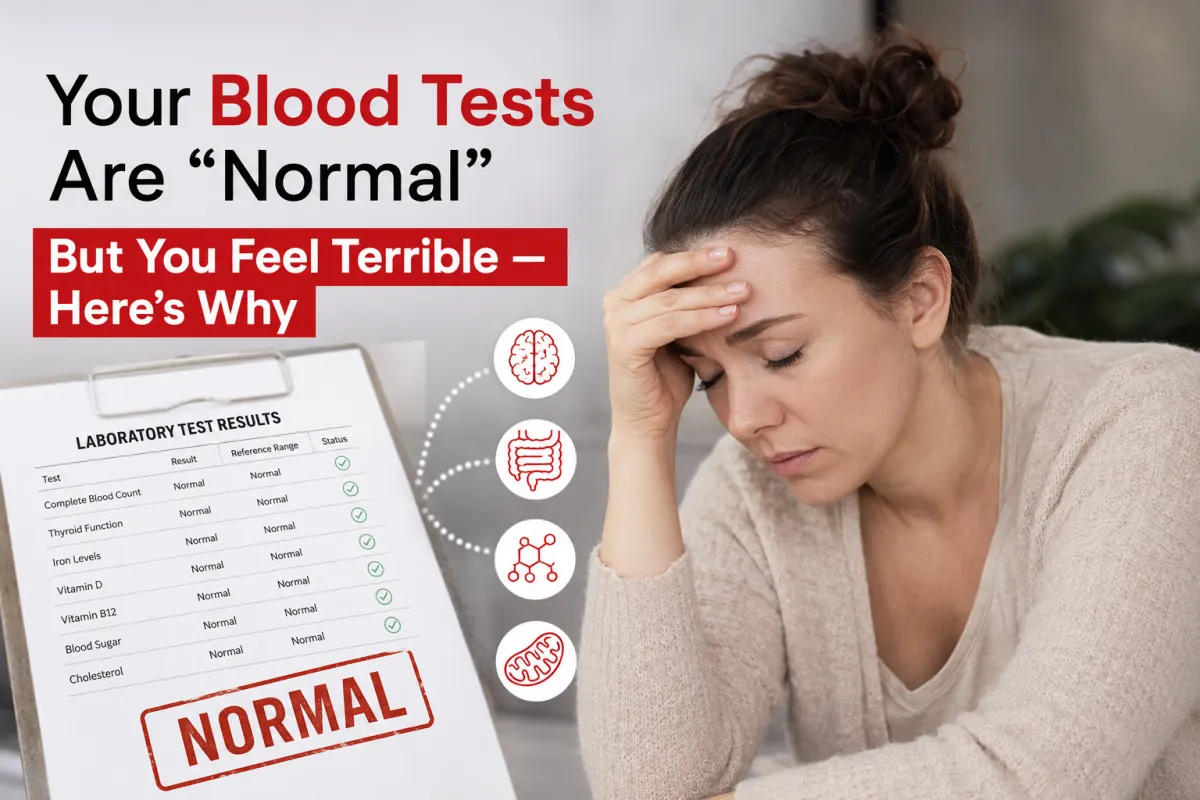
Blood Tests Normal But You Feel Terrible?
Quick answer: If your blood work came back "normal" but you still feel exhausted, foggy, and off, it's usually because standard lab reference ranges are wide population averages built to catch disease—not to detect early dysfunction or how your cells are actually functioning. Blood is also tightly regulated and shows a single moment in time, so it can look fine while tissue-level mineral patterns, stress physiology, and nutrient depletion tell a very different story.
You know the feeling. You finally made the appointment. You described the fatigue that sleep doesn't fix, the brain fog, the bloating, the wired-but-tired nights. They ran the standard panel. A few days later: "Good news—everything looks normal."
Except nothing feels normal. If you're a woman between 35 and 60 who has heard this more than once, you are not imagining it, and you are not alone.
Why do I feel sick if my blood tests are normal?
There are three big reasons a person can feel unwell while their labs look "fine."
1. "Normal" is a wide average, not "optimal for you." A lab reference range is defined as the central 95% of results from a healthy reference population — the 2.5th to 97.5th percentiles, per the standard IFCC/CLSI approach used in clinical laboratory methods. By design, that means about 5% of healthy people fall outside it, and the "normal" band itself is wide. You can land inside the range and still be far from where you function best. Many functional and integrative clinicians describe interpreting labs twice—once against the disease-reference range, and again against a narrower "optimal" range that better explains symptoms.
2. Blood shows the bloodstream, not the inside of your cells. A standard blood draw is a snapshot of what's circulating at that moment—and your body works hard to keep blood values stable. Serum calcium, for example, is tightly regulated by hormones and stays in range even when tissue stores are being depleted. So blood can look reassuring while the cellular and tissue picture is shifting.
3. Standard panels are narrow. A typical visit often includes a CBC and a TSH and little else. That rules out very little. Full thyroid markers, ferritin, nutrient status, and stress-related patterns frequently aren't checked at all.
What does "optimal" mean versus "normal"?
Here's a concrete example clinicians see constantly: ferritin (your iron-storage protein). Many labs flag ferritin as low only below about 15–30 ng/mL. But functional and dermatology literature often targets ferritin above roughly 70 ng/mL for energy, thyroid conversion, and hair health. And the link to hair loss is well documented: research published in the Journal of Investigative Dermatology (Rushton and colleagues) found mean ferritin significantly lower in women with hair loss — around 37 ng/mL in androgenetic alopecia and 25 ng/mL in alopecia areata, versus about 60 ng/mL in controls — with one analysis finding a ferritin at or below 30 μg/L raised the odds of telogen effluvium (diffuse shedding) roughly 21-fold. A ferritin of 25 gets reported as "normal"—while you're exhausted, losing hair, and foggy.
Iron is also required to convert your thyroid's T4 into active T3. So a woman with a TSH near the top of "normal," free T3 near the bottom, ferritin in the 20s, and vitamin D barely above 30 can be labeled perfectly fine on paper and still feel cold, tired, and foggy—because each marker is "in range" but the pattern describes someone set up to feel awful.
What could be causing my symptoms if it's not showing on labs?
For many women in this stage of life, the missing pieces fall into a few buckets:
Suboptimal (not deficient) nutrients — iron/ferritin, vitamin D, B12, and minerals sitting in the low-normal zone.
Mineral imbalances at the tissue level — the ratios between minerals like magnesium, potassium, sodium, and calcium influence energy, sleep, and how your nervous system holds tone. These patterns don't show up on a standard panel.
Stress physiology / nervous-system dysregulation — chronically elevated (or exhausted) stress signaling affects sleep, digestion, and energy long before it shows up as "disease."
The perimenopause transition — fluctuating estrogen and progesterone drive fatigue, sleep disruption, and mood changes that routine labs won't capture.
At Clarity Integrative Wellness, this is exactly the gap we're built for. When the whole picture points to how your body is functioning—not just whether you have a diagnosable disease—we look deeper. That's why every one of our programs includes practitioner-reviewed hair tissue mineral analysis (HTMA), a screening tool that reflects mineral patterns in tissue over roughly the last three months, giving us information a single blood draw simply can't.
How can hair tissue mineral analysis help when blood tests are "normal"?
HTMA is not a replacement for blood work—the two answer different questions. Blood is best for the current, acute snapshot. HTMA reflects tissue-level mineral trends and the ratios between key minerals over about 8–12 weeks. Those ratios can point toward stress patterns, energy/metabolic tendencies, and mineral depletion that a normal blood panel won't reveal. Reviewed by a qualified practitioner and paired with your symptoms and history, it helps connect the dots.
We'll be honest about its limits, too: HTMA is a screening tool, its reliability depends on using a certified lab and skilled interpretation, and it is best used alongside—not instead of—conventional testing and clinical judgment.
What should I do if my labs are normal, but I still feel off?
Get copies of your actual results (don't accept "everything's fine"—look at the numbers).
Ask about optimal ranges, not just the reference range, especially for ferritin, full thyroid (TSH, free T3, free T4), vitamin D, and B12.
Consider tissue-level and stress-pattern testing to see what a snapshot blood draw misses.
Work with someone who listens to symptoms, not just numbers.
You deserve the whole picture—and answers that match how you actually feel.
Frequently Asked Questions
Why do my blood tests come back normal when I feel so tired? Standard reference ranges are wide population averages (the central 95% of a healthy population) designed to catch disease, not early dysfunction. Blood is also tightly regulated and shows only a moment in time, so it can look normal while nutrient depletion, tissue mineral imbalances, or stress physiology drive your symptoms.
What is the difference between a "normal" and "optimal" lab result? "Normal" means you fall inside the broad reference range. "Optimal" is a narrower window where most people actually feel and function well. You can be technically normal but functionally suboptimal—common with ferritin, thyroid, and vitamin D.
What tests should I ask for if I still feel unwell? Beyond a basic panel, consider full thyroid markers (TSH, free T3, free T4), ferritin, vitamin D, B12, and tissue-level mineral assessment. Discuss which are right for you with a licensed provider.
Is HTMA better than a blood test? Neither is "better"—they answer different questions. Blood captures the current moment; HTMA reflects tissue mineral trends and ratios over about three months. Used together, and interpreted by a practitioner, they give a fuller picture.
Could perimenopause explain normal labs but real symptoms? Yes. Fluctuating estrogen and progesterone commonly cause fatigue, disrupted sleep, and mood changes that don't reliably show up on routine labs, which is why symptoms matter as much as numbers.
This article is for educational purposes only and is not medical advice, diagnosis, or treatment. HTMA is a screening tool, not a diagnostic test. Always consult a licensed provider before changing your health regimen.
Ready to understand what your "normal" labs are missing? Watch our free webinar, "The Real Reason Gut Protocols Stop Working," to see how the sleep-stress-gut connection may explain what you're feeling → Register for the free webinar.
Or explore our practitioner-reviewed HTMA programs → See our programs.


