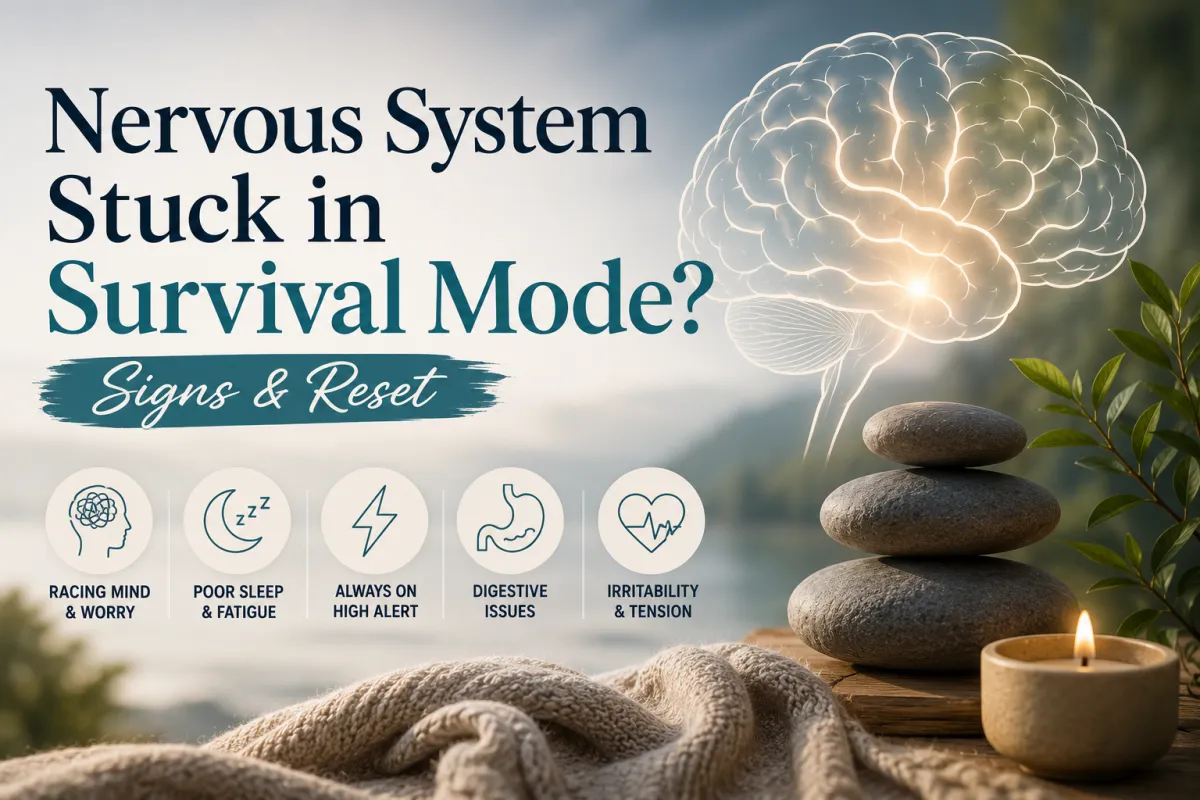
Nervous System Stuck in Survival Mode? Signs & Reset
Your nervous system is "stuck in survival mode" when chronic stress keeps you locked in fight-or-flight and you can't fully return to a calm, "rest-and-digest" state. Signs include feeling wired-but-tired, waking at 3am, poor stress tolerance, digestive issues, muscle tension, and brain fog. Because prolonged stress also burns through calming minerals like magnesium, willpower and supplements alone often aren't enough resetting requires signaling safety to your body and replenishing what stress depleted.
Do you feel "on" all the time—even when nothing is wrong? Heart a little fast, mind scanning for the next problem, unable to truly relax, yet also bone-tired? If you're functioning on the outside but never feel safe enough to rest on the inside, your nervous system may be stuck in survival mode.
This isn't weakness or a character flaw. It's biology and it's incredibly common in women juggling careers, caregiving, and midlife hormone shifts.
What does it mean to be stuck in survival mode?
Your autonomic nervous system has two branches. The sympathetic branch runs "fight-or-flight"—it's meant for short bursts of danger. The parasympathetic branch runs "rest-and-digest"—where sleep, digestion, and repair happen. In a healthy system, you activate under stress and then recover. Stanford
Survival mode is what happens when the stress response stays switched on and you can't fully downshift back to calm. The threat passes, but your body never got the "all clear." Over time it prioritizes staying alert over resting, digesting, and healing. At Clarity Integrative Wellness, we call this stuck state the Survival Mode Lock and it's often the hidden reason nothing else seems to work.
What are the signs your nervous system is in survival mode?
Common signs include:
Feeling "wired-but-tired"—exhausted but unable to switch off
Waking at 3am with a racing mind
Poor stress tolerance; small things feel overwhelming
Digestive issues (bloating, irregularity) that flare with stress
Persistent muscle tension, jaw clenching, headaches
Brain fog and difficulty concentrating
Feeling hypervigilant, on edge, or easily startled
Swinging between "go-go-go" and total shutdown/burnout Sereniumwellness
Trouble relaxing even during downtime
You don't need all of them. If several sound familiar, it's worth paying attention.
Why does the nervous system get stuck?
A few drivers tend to stack up:
Chronic, unrelenting stress with no real recovery between demands
Poor or broken sleep, which keeps stress signaling elevated
Unresolved life load or past stress/trauma that keeps the system primed for danger
Sensory overload—constant screens, notifications, and noise
Mineral depletion — and this one is under-appreciated
That last point is key. Chronic stress increases the loss of calming minerals like magnesium, and low magnesium in turn makes you more reactive to stress. As Pickering and colleagues describe in Nutrients (2020), "stress could increase magnesium loss, causing a deficiency; and in turn, magnesium deficiency could enhance the body's susceptibility to stress." Stress burns through the very minerals your nervous system needs to calm down, so the harder you push, the more depleted and more stuck—you become.
Why can't I just "relax" my way out of it?
Because the problem is physical, not just mental. When your body is mineral-depleted, low on vagal tone, and running on cortisol, "just relax" is like telling a car with an empty tank to drive. This is also why a single supplement, or a spa day rarely fixes it: they don't address the whole loop of stress signaling plus depleted raw materials.
It's also why gut protocols and sleep fixes so often fail in people who are stuck here. If the nervous system is locked in survival, digestion is suppressed and sleep stays shallow no matter what you add on top.
How do you reset a nervous system stuck in survival mode?
The goal is to send your body repeated, believable cues of safety—and refuel what stress drained. A realistic approach:
Daily "safety signals." Slow, long-exhale breathing, humming or singing, gentle rhythmic movement (walking), morning sunlight, and time in nature all help nudge you toward "rest and digest." Small, consistent cues matter more than occasional big efforts. The Conversation
Protect sleep like it's medicine. Consistent wake time, a wind-down routine, and steady overnight blood sugar help your system stand down.
Replenish depleted minerals. Address what stress burned through—through mineral-rich food and, where appropriate, general mineral support (to support normal nervous-system and energy function, not to treat disease).
Test don't guess. This is where practitioner-reviewed HTMA helps. Mineral ratios like sodium-to-potassium can reflect where you are in the stress response, and levels of magnesium, potassium, sodium, and calcium show what's been depleted—giving a personalized starting point instead of throwing supplements at the wall.
Get support for the deeper layers. If unresolved stress or trauma keeps the system on high alert, body-based approaches and professional support can be genuinely helpful. Choosing Therapy
The Clarity approach
Our Clarity 360 Framework is built around exactly this: addressing the sleep-stress-gut connection and the Survival Mode Lock as the foundation—before piling on more protocols. Using practitioner-reviewed HTMA, we map your stress and mineral patterns, then help you rebuild calm from the ground up, so the rest of your health efforts finally have a body that can respond.
You're not broken. Your nervous system has been doing its job—protecting you—for a very long time. The work is teaching it that it's safe to rest again.
Frequently Asked Questions
What are the signs of a nervous system stuck in survival mode? Feeling wired-but-tired, 3am waking, poor stress tolerance, stress-related digestive issues, muscle tension, brain fog, hypervigilance, and swinging between overdrive and shutdown are common signs.
How do I get my body out of fight-or-flight? Send consistent safety cues (slow-exhale breathing, gentle movement, morning light, protected sleep) and replenish minerals that stress depletes. Testing your mineral and stress patterns helps personalize the plan. Deeper stress or trauma may benefit from professional support.
Can being stuck in survival mode affect my gut and sleep? Yes. In fight-or-flight, digestion is suppressed and sleep stays shallow, which is why gut protocols and sleep fixes often underperform until the nervous system is addressed.
Why don't supplements alone fix survival mode? Because the issue is a whole loop—elevated stress signaling plus depleted minerals and low vagal tone. Supplements can help as part of a bigger plan, but they don't switch off the alarm by themselves.
How can HTMA help with nervous system dysregulation? Practitioner-reviewed HTMA can reveal mineral depletion and stress-related ratio patterns, giving a personalized picture of what your nervous system is missing—used alongside symptoms, not as a diagnosis.
This article is for educational purposes only and is not medical advice. HTMA is a screening tool, not a diagnostic test. Mineral references describe general structure/function support and are not intended to diagnose, treat, cure, or prevent disease. Consult a licensed provider.
Ready to help your body feel safe enough to rest again? Watch our free webinar, "The Real Reason Gut Protocols Stop Working," to understand the Survival Mode Lock → Register for the free webinar.
Or explore programs with practitioner-reviewed HTMA → See our programs.
