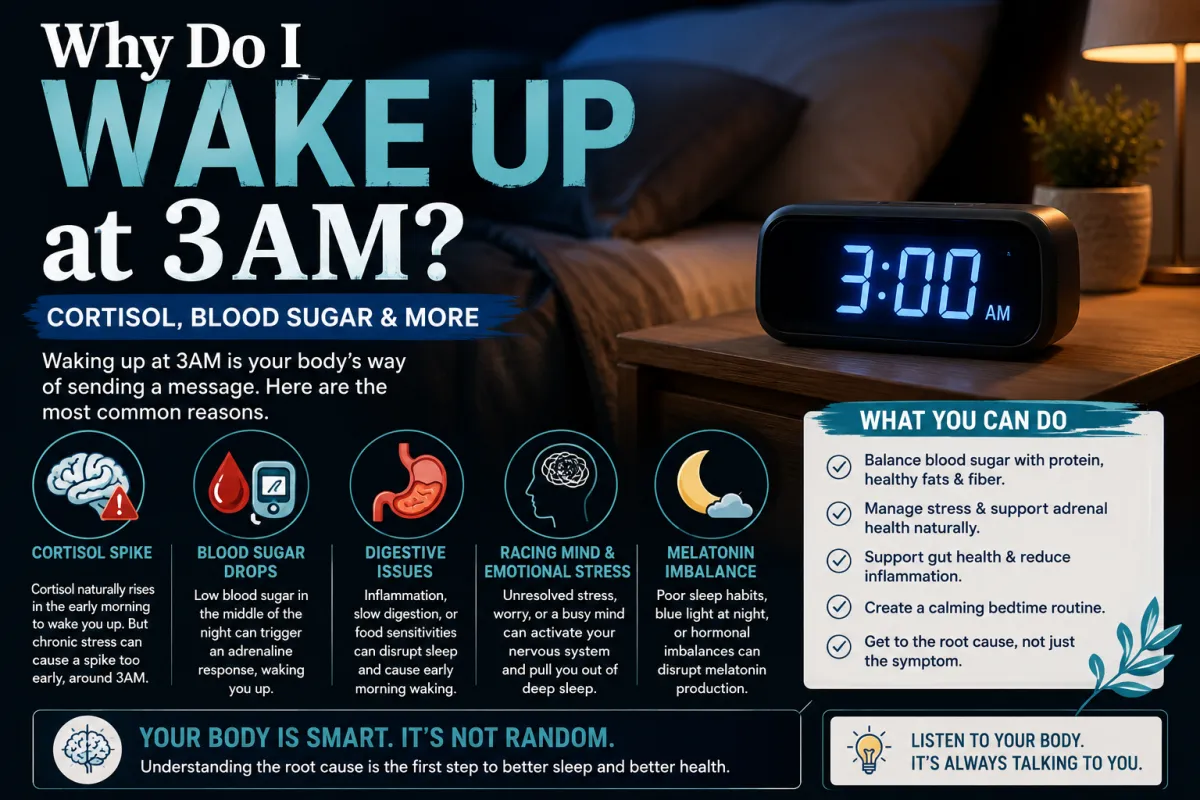
Why Do I Wake Up at 3am? Cortisol, Blood Sugar & More
Waking at 3am is most often driven by a cortisol spike. Cortisol naturally starts rising in the early morning hours; if your stress system is over-activated—or your blood sugar drops overnight—that rise can hit too hard and jolt you awake. Depleted calming minerals like magnesium and potassium, perimenopausal hormone shifts, and a nervous system stuck in "fight-or-flight" all make it more likely and harder to fall back asleep.
It's 3am. Again. You're wide awake, mind racing, maybe with a little jolt of anxiety—and the harder you try to sleep, the more awake you feel. If this has become your nightly pattern, there are real, physical reasons for it. It's not "just stress," and it's not in your head.
Why do I keep waking up at 3am specifically?
Your body runs on a roughly 24-hour cortisol rhythm. Cortisol should be lowest around midnight, then begin climbing in the early morning hours. Part of that climb is the cortisol awakening response (CAR)—a natural surge of roughly 50% (studies report a range of about 38–75%) that peaks 30–45 minutes after you wake, seen in the large majority of healthy people. In an ideal night, you sleep right through the early part of that rise.
But if your stress system (the HPA axis) is over-sensitized from chronic stress, that early-morning cortisol rise can be exaggerated—registering as an internal "alarm" that flips on your fight-or-flight response and pulls you out of sleep, sometimes with a feeling of dread. You're also in lighter sleep stages in the second half of the night, so you're simply easier to wake. Biology Insights
Is it blood sugar or cortisol waking me up?
Often it's both, working together. If your blood sugar drops too low overnight (nocturnal hypoglycemia)—common after a high-sugar dinner, alcohol, or an unbalanced late meal—your body reads that dip as an emergency and releases cortisol and adrenaline to raise it back up. That surge is more than enough to wake you. Biology Insights
This is why what and when you eat in the evening matters so much: a balanced dinner with protein, fat, and fiber (and going easy on late alcohol and sugar) helps keep blood sugar—and cortisol—steadier through the night.
What role do minerals play in 3am waking?
This is the piece most sleep advice skips. Minerals are the raw materials your nervous system uses to calm down.
Magnesium helps calm the nervous system and supports a healthy stress response. Here's the catch: stress itself depletes magnesium, and low magnesium makes you more reactive to stress. Researchers Pickering and colleagues describe this in Nutrients (2020): "stress could increase magnesium loss, causing a deficiency; and in turn, magnesium deficiency could enhance the body's susceptibility to stress"—a self-reinforcing loop they call the vicious circle.
Potassium and sodium are deeply tied to your stress and adrenal signaling; their balance reflects how much "vitality" reserve your body has to cope.
Calcium and magnesium together help regulate the hormones that govern rest, and an imbalance can tilt you toward more cortisol at night.
If chronic stress has quietly burned through your calming minerals, your nervous system has fewer resources to keep you asleep through that early-morning cortisol rise. This is exactly the kind of pattern practitioner-reviewed HTMA is designed to surface.
Why is 3am waking so common in perimenopause?
If you're a woman in your 40s or 50s, hormones add another layer. Progesterone is naturally calming and sleep-supporting—as it declines and fluctuates in perimenopause, sleep becomes lighter and you become more sensitive to cortisol spikes. Falling estrogen also disrupts sleep architecture and temperature regulation (hello, 3am night sweats). So the same cortisol rise that you once slept through can now wake you cold, wired, and frustrated.
The bigger picture: a nervous system stuck "on"
Notice the theme connecting all of this—cortisol, blood sugar, minerals, hormones. Underneath them is a nervous system that can't fully downshift into "rest and digest." When your body is stuck in prolonged fight-or-flight—what we at Clarity call the Survival Mode Lock—3am waking becomes the nightly symptom of a system that never fully stood down.
That's also why sleeping pills or a single magnesium capsule often aren't enough on their own: they don't address why the alarm keeps going off.
What helps with waking up at 3am?
Start with the foundations that signal safety to your nervous system:
Balance your dinner and limit late alcohol/sugar to steady overnight blood sugar.
Get morning light and keep a consistent wake time to anchor your cortisol rhythm.
Wind down with a slow, long exhale (breathe out longer than you breathe in) to activate "rest and digest" before bed.
Support calming minerals through food and, where appropriate, general mineral support (to support normal nervous-system function—not to treat a condition).
Look for the pattern, don't just chase symptoms. If 3am waking is chronic, understanding your stress and mineral picture—rather than guessing—is what changes things.
Persistent insomnia can also have other medical causes (including sleep apnea and thyroid issues), so ongoing sleep problems deserve a proper evaluation with a licensed provider.
Frequently Asked Questions
Why do I wake up at 3am every night? Most often because cortisol naturally rises in the early morning and an over-activated stress system (or an overnight blood sugar dip) turns that rise into an "alarm" that wakes you. Depleted calming minerals and hormone shifts make it worse.
Is waking at 3am a sign of high cortisol? It can reflect a cortisol spike or an over-sensitized stress response, especially if you wake feeling anxious or wired. It's not a diagnosis on its own—patterns should be evaluated in context.
Can low magnesium cause me to wake at night? Low magnesium is linked to poorer sleep and a heightened stress response, and stress depletes magnesium further. Restoring mineral balance can support healthier sleep, though it should be part of a bigger picture.
Why did 3am waking start in perimenopause? Declining, fluctuating progesterone (which is calming) and estrogen disrupts sleep and increases sensitivity to cortisol spikes, making early-morning waking more common in your 40s and 50s.
When should I see a professional about waking at 3am? If it's frequent, affects your days, or comes with symptoms like loud snoring or gasping, see a licensed provider to rule out sleep apnea, thyroid, and other causes.
This article is for educational purposes only and is not medical advice. Mineral references describe general structure/function support and are not intended to diagnose, treat, cure, or prevent disease. Consult a licensed provider.
Tired of 3am wake-ups? Our free webinar, "The Real Reason Gut Protocols Stop Working," explains the sleep-stress-gut connection behind restless nights → Register for the free webinar.
Want to see your own stress and mineral patterns? → Explore our HTMA programs.
