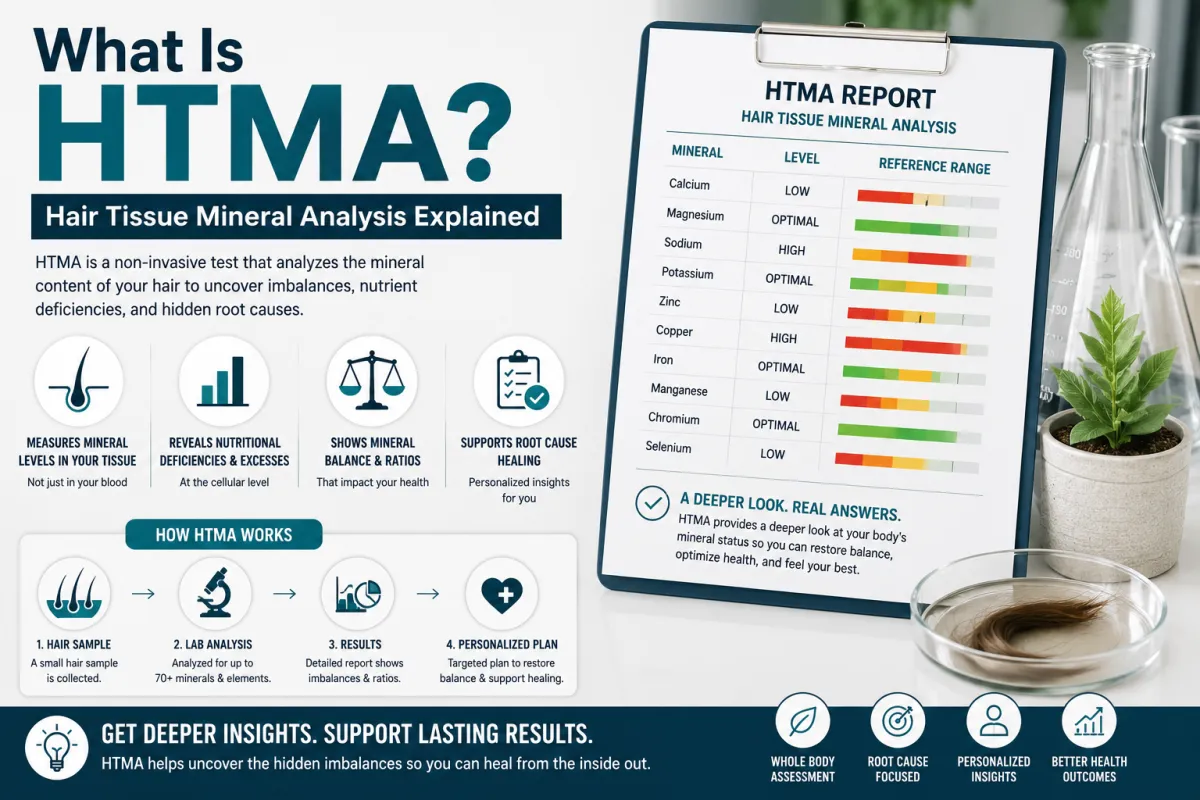
What Is HTMA? Hair Tissue Mineral Analysis Explained
Hair tissue mineral analysis (HTMA) is a non-invasive screening test that measures the levels of minerals and toxic metals in a small hair sample, reflecting tissue-level patterns over roughly the last three months. Its real value is in showing mineral ratios and long-term trends—patterns tied to stress, energy, and metabolism—that a single blood draw can't capture. It's a screening tool, not a diagnosis, and works best interpreted by a practitioner alongside your symptoms and other testing.
If you've been told your labs are "normal" but you still feel exhausted, wired, foggy, or stuck, you may have come across HTMA online. Let's cut through the hype (and the criticism) and explain what this test actually is, what it can genuinely tell you, and where it falls short.
What is hair tissue mineral analysis?
HTMA analyzes a small sample of hair—usually cut close to the scalp at the back of the head—to measure the concentration of essential minerals (like magnesium, potassium, sodium, calcium, and zinc) and toxic metals (like lead, mercury, arsenic, and cadmium). As hair grows at roughly one centimeter per month, it incorporates minerals from the body during formation, so a sample reflects a window of about the last 8–12 weeks.
Certified labs typically use ICP-MS (inductively coupled plasma mass spectrometry), a precise method for detecting even trace amounts of each element.
What does an HTMA test show that a blood test doesn't?
This is the key distinction. Blood is tightly regulated and reflects the current moment—what's circulating right now. HTMA reflects what's been happening in tissue over time. They answer different questions.
The most useful part of HTMA isn't any single number—it's the ratios between minerals, which can reflect how systems are trending:
Sodium-to-potassium ratio — often called the "vitality" or stress ratio; reflects the adrenal/stress response. Both an elevated and an inverted (low) ratio are considered signs of stress on the body—one pointing toward acute alarm, the other toward chronic depletion. Hormone Healing RD
Calcium-to-magnesium ratio — related to blood-sugar handling and the balance between "fight-or-flight" and "rest-and-digest" tone.
Calcium-to-potassium ratio — associated with thyroid/metabolic tendencies at the tissue level. Health Balancing
These patterns can help explain why someone feels burnt out, wired-but-tired, or unable to recover from stress even when a blood panel looks unremarkable.
Is HTMA accurate? An honest look
Here's where we're going to be straight with you, because trust matters more than hype.
Where HTMA is well-supported: Hair is a validated tissue for screening long-term exposure to toxic metals like lead and mercury—this is used in public-health biomonitoring. It's also a reasonable way to track long-term mineral trends. Modern ICP-MS labs report far tighter measurement variability (on the order of 5–10%) than the technology behind older criticisms.
Where HTMA has real limits:
It is a screening tool, not a diagnostic test. It doesn't diagnose disease.
For detecting an acute single-nutrient deficiency, blood tests are generally more reliable. Hair mineral levels don't always track serum or intracellular levels for every mineral.
Results depend heavily on which lab runs them and on skilled interpretation. This is the core of the historic criticism: Seidel and colleagues (JAMA, 2001) split one hair sample across six U.S. commercial labs and concluded the analyses were "unreliable," advising practitioners to "refrain from using such analyses to assess individual nutritional status"—echoing Stephen Barrett's earlier 1985 JAMA paper, "Commercial Hair Analysis: Science or Scam?" Using a certified lab and a trained practitioner is what separates a usable result from a confusing one.
The honest takeaway: HTMA is a valuable piece of the puzzle when used correctly—not a crystal ball, and not a replacement for conventional care. Anyone who tells you it can diagnose your conditions on its own is overselling it.
Who might benefit from HTMA?
HTMA may be worth considering if you:
Feel exhausted, foggy, or "off" despite normal blood work
Struggle with poor sleep, waking at 3am or feeling wired-but-tired
Feel stuck in chronic stress and can't seem to recover
Want to understand mineral depletion and stress patterns behind your symptoms
How does Clarity use HTMA?
At Clarity Integrative Wellness, HTMA is included in every program—but we never read it in isolation. As dual board-certified nurse practitioners, we interpret your HTMA alongside your full symptom history, sleep, stress, and gut picture, and conventional testing where appropriate. We use it to understand the sleep-stress-gut connection and to identify whether your body may be stuck in what we call the Survival Mode Lock—a prolonged stress state that helps explain why supplements and gut protocols keep failing.
That practitioner review is the difference between a confusing printout and an actual roadmap.
How is an HTMA sample collected?
It's simple and painless. A small amount of hair (about a quarter gram) is cut close to the scalp at the back of the head. If you color your hair, your practitioner will guide you on timing. The sample is sent to a certified lab, and results typically return in about two weeks.
Frequently Asked Questions
What does HTMA test for? It measures levels of essential minerals and toxic metals in a hair sample and calculates key mineral ratios, reflecting tissue-level patterns over roughly the last three months.
Is HTMA better than a blood test? Neither is better—they answer different questions. Blood shows the current moment and is more reliable for acute deficiencies; HTMA reflects longer-term tissue mineral trends and ratios. Used together they give a fuller picture.
Is hair mineral analysis scientifically valid? Hair is a validated tissue for screening long-term toxic-metal exposure and for tracking mineral trends. It is less reliable for diagnosing single acute deficiencies, and quality depends on a certified lab and skilled interpretation. It's a screening tool, not a diagnostic test.
How long does hair mineral analysis reflect? About 8–12 weeks (roughly three months), based on the average rate of hair growth.
Do I need a practitioner to interpret HTMA? Strongly recommended. The value is in interpreting ratios and patterns in the context of your symptoms and history—something a raw printout can't do on its own.
This article is for educational purposes only and is not medical advice. HTMA is a screening tool, not a diagnostic test, and does not diagnose, treat, cure, or prevent disease. Consult a licensed provider.
Curious what your minerals reveal about your stress and sleep? Start with our free webinar, "The Real Reason Gut Protocols Stop Working"
→ Register for the free webinar.
Or explore programs that include practitioner-reviewed HTMA → See our programs.


