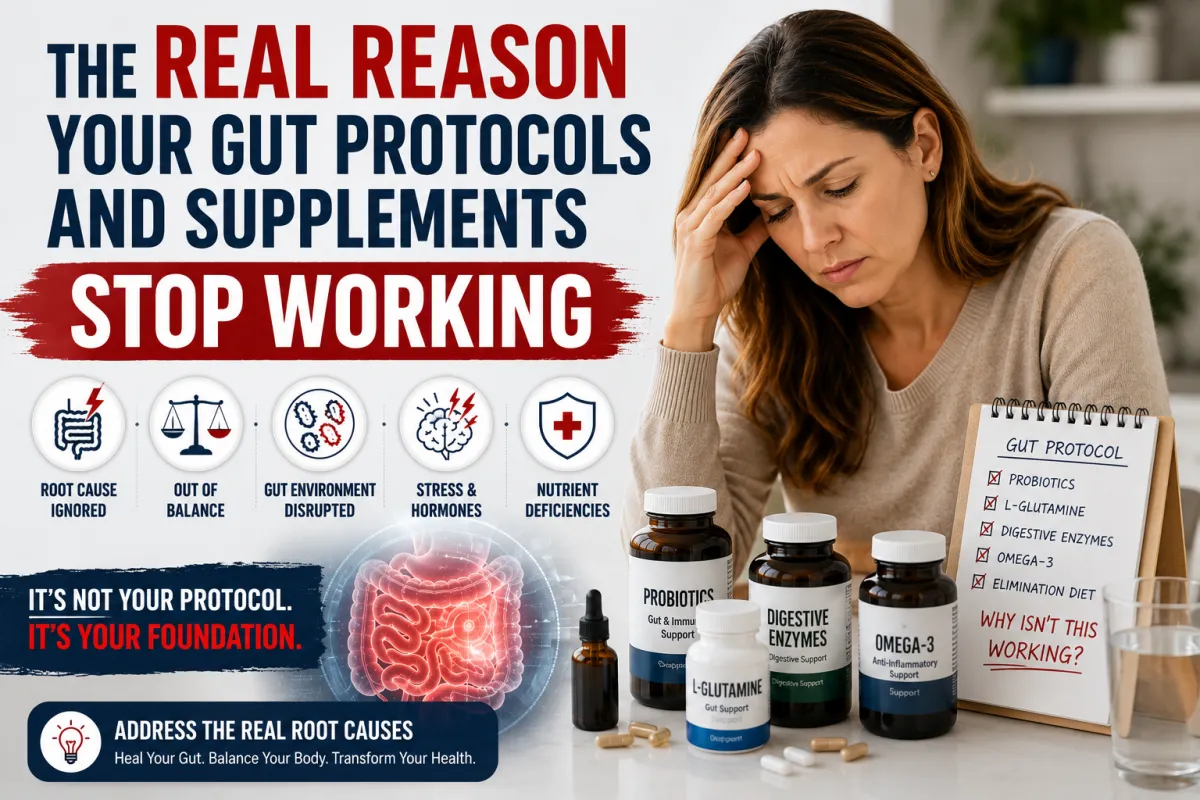
Why Gut Protocols & Supplements Stop Working
Gut protocols and supplements often stop working because the body is stuck in a prolonged stress state—what we call the Survival Mode Lock. When your nervous system stays in "fight-or-flight," it diverts blood and energy away from digestion, alters stomach acid and gut motility, depletes key minerals, and increases gut permeability. In that state, even the best protocol can't fully take hold, because the terrain it depends on isn't working.
You've done the work. The elimination diet. The probiotics. The gut-healing powders, the digestive enzymes, the expensive practitioner-grade capsules. Maybe it helped for a few weeks—then stalled. Or maybe it never really moved the needle at all.
If that's you, please hear this: you are not failing, and you're not "not trying hard enough." The problem is usually that the protocol was applied on top of a body that isn't in a state to use it.
Why do supplements and gut protocols stop working?
There are a few common reasons—and most of them trace back to one root.
Your gut environment isn't ready to absorb them. Supplements don't act by magic; they depend on a working digestive sequence—adequate stomach acid, enzymes, a healthy gut lining, and proper motility. If digestion is impaired, nutrients can pass through largely unused, no matter how high-quality the product.
You may be feeding the wrong thing. Adding probiotics or prebiotic fiber makes sense in isolation—but if there's bacterial overgrowth (like SIBO) or fungal overgrowth, those same interventions can worsen bloating and brain fog. The logic is right; the context is wrong.
The real root: your body is stuck in a stress state. Here's the piece most protocols ignore. Your gut only works well when your nervous system feels safe enough to run "rest and digest." When you're chronically stressed, the opposite system runs the show—and it actively shuts digestion down.
What is the "Survival Mode Lock"?
Your autonomic nervous system has two modes. The sympathetic ("fight-or-flight") mode is built for short-term threats. The parasympathetic ("rest and digest") mode is where digestion, repair, and deep sleep happen. In a healthy day, you flow between them. Stanford
The Survival Mode Lock is what we at Clarity Integrative Wellness call the state where the body gets stuck in prolonged fight-or-flight and can't fully switch back. Chronic stress, poor sleep, blood-sugar swings, unresolved life load, and mineral depletion can all keep that alarm switch flipped on. And when your body believes it's in survival, healing your gut is simply not its priority—staying alert is.
This is the real reason gut protocols stop working. You can't supplement your way out of a nervous system that's convinced it's in danger.
How does stress physically shut down digestion?
This isn't a metaphor—it's physiology:
Blood flow is redirected. In fight-or-flight, blood moves to your muscles and brain and away from the digestive tract, slowing the whole system down. uspto
Motility changes measurably. A physiology review in the American Journal of Physiology–Gastrointestinal and Liver Physiology (Taché et al.) notes that "the most consistent pattern of GI motor alterations induced by various acute stressors is that of delaying gastric emptying while accelerating large bowel transit." Experimental work on acute mental stress (Holtmann et al., Digestive Diseases and Sciences) measured the interdigestive motor cycle lengthening by about 60% and duodenal flow dropping more than 50% in the rest period afterward.
Cortisol raises gut permeability. Chronically elevated cortisol has been shown to increase intestinal permeability, which can trigger inflammation—so the very lining you're trying to heal keeps getting undermined.
The vagus nerve gets suppressed. The vagus nerve is the main highway of "rest and digest." When stress hormones stay high, vagal signaling is dampened, and digestion, motility, and even the microbiome suffer. Dr HagmeyerBreatheWorks
Minerals get burned through. Chronic stress increases loss of minerals like magnesium, and low magnesium in turn makes you more reactive to stress. As Pickering and colleagues put it in Nutrients (2020), "stress could increase magnesium loss, causing a deficiency; and in turn, magnesium deficiency could enhance the body's susceptibility to stress"—a self-reinforcing loop they call the vicious circle.
So you can take the perfect probiotic in the middle of a stress-locked, mineral-depleted, low-vagal-tone system—and very little sticks.
Why does this happen so often to women 35–60?
This age range stacks the deck. Career and caregiving loads are often at their peak. Sleep is frequently disrupted. And perimenopause adds fluctuating estrogen and progesterone—progesterone is calming and sleep-supporting, so as it drops, many women become more sensitive to stress and cortisol spikes. Layer years of "push through it" on top, and the nervous system quietly settles into Survival Mode Lock.
How do you actually break the cycle?
The order of operations matters. Instead of stacking another protocol on top, the goal is to address the terrain first:
Identify the stress pattern and mineral status. This is where practitioner-reviewed HTMA is genuinely useful. Mineral ratios such as sodium-to-potassium (often called the "vitality" or stress ratio) can reflect where your body is in its stress response, and levels of magnesium, potassium, sodium, and calcium show what's been depleted. It's a screening tool, interpreted alongside your symptoms—not a diagnosis.
Signal safety to the nervous system. Simple, consistent practices—slow exhale-focused breathing, morning light, gentle movement, and protecting sleep—help tip you toward parasympathetic "rest and digest."
Replenish what stress burned through. General mineral and nutrient support (used to support normal nervous-system and energy function, not to treat disease) helps rebuild the raw materials calm depends on.
Then—and only then—support the gut. Once the terrain can actually use it, gut support finally has a chance to hold.
This is the sequence behind our Clarity 360 Framework: address the sleep-stress-gut connection and the Survival Mode Lock first, so the work you do next actually lasts.
Frequently Asked Questions
Why did my gut supplements stop working after a few weeks? Often because the underlying terrain—stress state, mineral status, gut environment—wasn't addressed. If your body stays in fight-or-flight, digestion and absorption stay suppressed, so even good supplements lose traction over time.
Can stress really cause gut problems even with a clean diet? Yes. Chronic stress redirects blood away from digestion, alters motility, raises cortisol and gut permeability, and suppresses the vagus nerve. A perfect diet can still be undermined when the nervous system is stuck in survival mode.
What is the Survival Mode Lock? It's the term we use for a body stuck in prolonged fight-or-flight that can't fully return to "rest and digest." In that state, healing isn't the body's priority—staying alert is—which is why gut protocols and supplements underperform.
Should I stop taking my supplements? Don't make changes without talking to your provider. The point isn't that supplements are useless—it's that they work best once the nervous system and mineral foundation are addressed first.
How do I know if stress is behind my gut issues? Clues include waking at 3am, feeling wired-but-tired, poor stress tolerance, and gut symptoms that flare with stress. Practitioner-reviewed testing like HTMA can help reveal stress and mineral patterns behind the scenes.
This article is for educational purposes only and is not medical advice. Supplement references are general structure/function support and are not intended to diagnose, treat, cure, or prevent disease. Consult a licensed provider.
Want the full explanation of why nothing has worked yet? Our free webinar, "The Real Reason Gut Protocols Stop Working," walks through the Survival Mode Lock step by step →
Register for the free webinar.
Ready to test instead of guess? → Explore our HTMA programs.


